 English
 Español
 Portugues
 Pусский
 Deutsch
 العربية
 हिन्दी
 Indonesia
 Tiếng Việt


Steel Structure Components
Steel structures are composed of several key components that work together to provide strength, stability, and durability. Understanding these elements is essential for the design, fabrication, and erection of modern steel buildings, bridges, industrial plants, and infrastructure.The primary load‑bearing members are columns and beams. Columns are vertical elements designed mainly to carry compressive loads from floors, roofs, and other structural parts down to the foundations. They are often made from rolled steel sections such as H‑shapes, I‑shapes, or built‑up box sections when higher capacities are required. Beams are horizontal members that resist bending and shear forces. They support slabs, decks, and secondary framing, transferring loads to the columns. Beams can be simple I‑beams, plate girders, or trusses, depending on span and loading requirements.Trusses are another fundamental component, formed by interconnected triangular units. They efficiently carry loads over long spans with relatively small amounts of material. Roof trusses and bridge trusses use chords, diagonals, and verticals to distribute forces mainly as axial tension and compression, reducing bending in individual members. Bracing systems complement the primary framing, providing lateral stability against wind, seismic forces, and imperfections. Bracing may be arranged in X, K, or V configurations using angles, rods, or hollow sections, and it helps control sway and buckling of the structure.Floor and roof systems in steel structures often use steel decking combined with concrete or insulation and waterproofing layers. Composite floor systems employ steel beams and profiled steel decks that act together with reinforced concrete slabs, improving strength and stiffness. Roof purlins and wall girts, usually cold‑formed sections such as C or Z shapes, span between main frames and support cladding and sheeting.Connections are critical components that join all members into a single structural system. Bolted and welded connections transfer forces between beams, columns, braces, and secondary members. Moment connections resist both shear and bending, ensuring frame continuity and lateral stiffness, while simple (shear) connections primarily transfer shear forces and allow rotation. Connection design must consider load paths, fabrication tolerances, erection sequence, and long‑term performance.Base plates and anchor bolts form the interface between steel columns and foundations. Base plates distribute loads from the column to the concrete, while anchor bolts resist uplift, shear, and overturning forces. Proper detailing of grout, leveling, and corrosion protection is essential for durability.Secondary components include staircases, handrails, platforms, and maintenance walkways, all typically fabricated from steel for consistency and ease of installation. Corrosion protection systems, such as galvanizing or paint coatings, and fire protection materials, including intumescent coatings or encasement, complete the structure and ensure safety and longevity.Together, these components create a versatile and efficient structural system that can be adapted to a wide range of architectural and engineering requirements.
Produit
Catégorie:
-
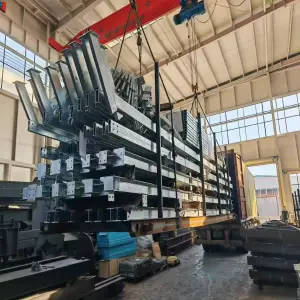
Steel Structure Warehouse Building For Industrial Storage
Leur classification: Steel StructureVues: 13Numéro:Temps de libération: 2026-03-24 15:04:03Steel Structure is a modern construction solution widely used in industrial, commercial, and residential projects due to its strength, flexibility, and cost efficiency. Made from high quality structural steel, these systems provide excellent load bearing capacity and long span design, making them ideal for warehouses, workshops, factories, office buildings, and agricultural facilities. Steel Structure buildings are prefabricated and manufactured with precision, ensuring fast installation, reduced construction time, and consistent quality. Compared with traditional concrete structures, steel offers superior durability, resistance to harsh weather conditions, and better seismic performance, which significantly improves safety and service life. In addition, Steel Structure components are recyclable and environmentally friendly, helping reduce construction waste and support sustainable development goals. The design of Steel Structure can be fully customized to meet specific project requirements, including size, layout, insulation, and ventilation systems, providing maximum space utilization and operational efficiency. Advanced surface treatments such as galvanizing and painting also enhance corrosion resistance, making the structure suitable for various climates and environments. With the advantages of lightweight materials, lower foundation costs, and easy maintenance, Steel Structure has become a preferred choice for global construction projects. Whether for large scale industrial use or small commercial buildings, Steel Structure delivers reliable performance, economic value, and long term stability, making it an essential solution in modern building engineering.
Actualités
Catégorie:
-
[Company News]Hanjing Steel Structure Wins General Contract for High-end E...
2026-03-28 13:26:59 -
[industry news]Hanxing Steel Structure Expands Global Market and Builds Str...
2026-03-28 14:23:43
Affaire
Catégorie:
Aucun résultat de recherche!
Vidéo
Catégorie:
Aucun résultat de recherche!
Téléchargement
Catégorie:
Aucun résultat de recherche!
Recrutement
Catégorie:
Aucun résultat de recherche!
Produits recommandés
Aucun résultat de recherche!



 WhatsApp
 Téléphone